
What The Bank Of Japan's Rate Hikes Reveal About How Japan Changes
- Gradual Change Is Deliberate, Not Stalled: The Bank of Japan’s measured 25-basis-point rate hikes reflect a core Japanese institutional preference for signposted, incremental adjustments rather than sudden, disruptive shifts.
- Three Habits Driving Japanese Decisions: Across both monetary policy and corporate governance, Japanese institutions prioritize reading the whole picture first, avoiding shock to stakeholders, and finding a consensus middle path through nemawashi (根回し).
- Pressure Changes Tempo, Culture Shapes Style: While external factors like inflation, global demand, and international pressure have accelerated the BoJ’s pace, the execution remains incremental unless an acute crisis (force majeure) forces rapid action.
- Strategic Lessons for Foreign Leaders: Global executives working in Japan should watch early signals rather than waiting for sudden triggers, build extra lead time into timelines for internal alignment, and engage stakeholders before change happens.
Written by Maya Matsuoka
At a CEO round table in November 2026, where we talked about the new prime minister and the necessity of the Bank of Japan to increase interest rates, an American journalist with a degree in economics asked why Prime Minister Takaichi would not “allow” the Bank of Japan to raise the interest rate straight to 2% or higher. The question was in response to my earlier comment that even if the prime minister gave a clear green light, the process would be staggered and would take time.
In their view, the economics was clear: the BoJ raises the interest rates by the end of the year, the underperforming companies, being unable to pay their debt go bankrupt, the bankruptcies release much needed by other corporations space and resources into the market, the economy takes off. Indeed, if we had only economics at play, this Q&A exchange would not have happened. But the economy functions in an environment where humans and their value systems are at play and this is something that many foreign companies in Japan keep running into: why a perfectly reasonable interest rate or global pay policy can hit a wall in Japan.
Where the policy stands today
On 30 October 2026, the Bank of Japan said that underlying inflation reached its 2% target, more than 13 years after setting it. The Policy Board voted 8 to 1 and held the 1.25% rate. The only dissenter, Hajime Takata, proposed a hike to 1.5%.
The vote shows how close the board is to the next step. The argument is no longer about whether to raise rates, but about when. The bank also decided to more than double the pace of its ETF sales, from about 330 billion yen a year to about 860 billion yen, starting in January 2027. That is another step towards normalization, taken in a measured way.
A year after the initial move towards normalization, before the next meeting on December 17 and 18, the numbers show what the rate increase process looks like.
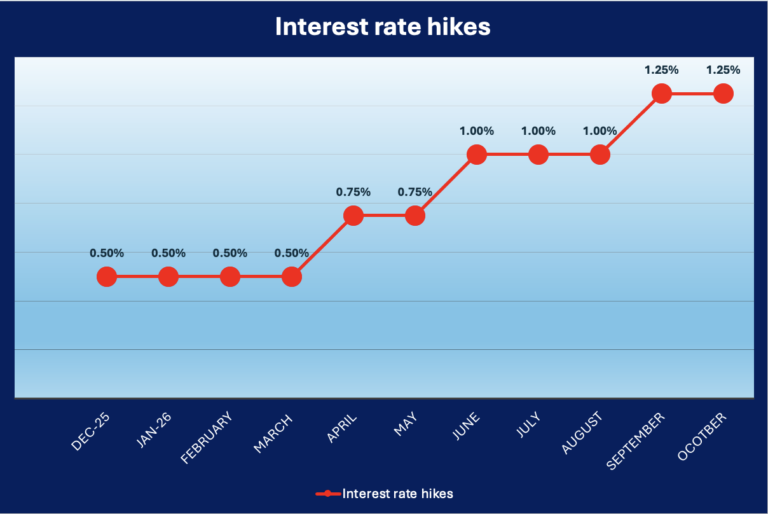
The policy rate rose by 75 basis points (0.75%) in three steps of 25 basis points each and the BoJ also held at other meetings in between.
The pace has changed but it isn't yet fast enough
Some analysts describe this pace as aggressive, while others, including US officials, have pushed for faster tightening. Both views are true because they are using different comparison bases.
Compared to the Bank of Japan’s own past
The few hikes that took place in the past 25 years, happened about twice a year, if at all. Reuters reported that the bank was considering moving faster than that rhythm, and the “dissident” Tanaka has described 2026 as a regime change towards more nimble, data-dependent moves. Looking at the standards of BoJ’s own habits during the past quarter century, this pace is indeed brisk.
Compared with other major central banks
The US Federal Reserve raised rates by roughly 5 percentage points in about 16 months in 2022 and 2023, including several 75-basis-point steps. Nothing the Bank of Japan has done so far resembles that. To be fair, the Fed was responding to much higher inflation. According to LPL Financial, historically, the Fed has a track record of hiking rates continuously until “something breaks” in the financial system, instantly triggering a recession. Currently, by pausing for months at a time, they are trying to let the economy absorb previous adjustments. (Other sources: https://eco3min.fr/en/fed-funds-rate-track-record-dataset/)
Compared to where rates may eventually settle, there is still room to grow
Reuters has described neutral rate as seen by markets at around 1.5%, and analysts polled by Reuters expect a hike to 1.5% in December with a final level of 1.75 to 2% afterwards. Daiwa expects next hike in December and another in April 2027, with rates peaking around 2%. These are analysts expectations and time will tell whether and when they turn into decisions.
My reading is that the pace has clearly changed but it is still gradual by international standards, and the bank has not yet moved as fast to neutral as the dissent of Hajime Takata and the pressure from Washington might suggest. I am not arguing that the pace should be faster. My point is that whether it is “slow” or “aggressive” depends on who you ask and what you compare it with, and that knowing how Japan operates will tell you what you could expect.
A divided board and a middle path
This year, the board is being pulled in both directions and we do not see events like this often
In September, Toichiro Asada and Ayano Sato, both appointed under PM Takaichi, wanted to hold. At earlier board meetings, the dissenters wanted to go faster. In October, Hajime Takata wanted to go faster. With hawks on one side, doves on the other, and pressure from Washington, the outcome remains in the middle: the policy rate increases by 25 basis points at a time, several months apart, and the direction is signaled in advance.
Why this pace is not surprising
Certain points and underlying cultural traits make the current pace relatively predictable.
The BoJ announced in advance that it would keep raising rates as economic and price conditions allow through its statements since the spring of 2026. The board is split between faster and slower, which draws decisions towards the middle. Outside pressure has raised the tempo without changing the form of the change and the same preference for gradual, non-disruptive, consensus-based steps appear across Japanese institutions.
The following is offered as a lens and not as a low of nature because individuals, institutions and generations differ. To add, economists would also point to fiscal and debt-service constraints, which are a significant factor to consider in any change-of-policy event.
But I also see three habits at work here, too. Habits that I recognize from 25 years of working inside Japanese organizations.
Reading the whole picture first
Governor Ueda has repeatedly said the bank is gathering data and information before moving, including from its branches across the country. In September, he gave four reasons for hiking: a worsening situation in the Middle East, stronger than expected AI-related demand, higher inflation expectations and firm wage data. This is an expression of the preference to weigh many factors together before acting be it by expressing an opinion or making a decision.
Avoiding shock
The bank signaled the path before each move and moved in small steps. Although this can be seen as hesitation, it is, in fact deliberation because the bank has hiked the rates three times in ten months. This is sequenced change, designed in a way that households, companies and markets are not caught off guard.
Reaching the middle through consensus
When a board contains different views, the Japanese organizations search for a position that everyone can live with. The pattern of dissents, in both directions, and the steady 25-basis-point outcomes are the result of that action. Sure enough, a divided board would produce gradualism in many parts of the world but the point here is how strongly the middle path is preferred in Japan.
Change without a crisis: why Japan prefers the gradual path
Contrary to common perception, Japan does change, but when nothing forces its hand, it prefers to change in small, signposted steps that disrupt as little as possible.
This goes well beyond monetary policy. In many Japanese organizations, a significant change is prepared through consultation (根回し, nemawashi), so that by the time a decision is made formal, the people affected have already seen it coming. This does not mean that the aim is to avoid change but to avoid shock so that relationships, routines and trust stay intact while things move.
The Bank of Japan’s history shows this. When it finally ended the negative interest rates in March 2024, it was the first rate rise in 17 years. From my background knowledge, the bank acted only after the spring wage talks showed that wage growth looked durable. In September, the hike to 1.25% was its sixth since that exit and each of them has been 25 basis points.
Incremental change has a price. Patience and graduation may look like indecisiveness to those unfamiliar with the process and while it is designed to protect stability, it can delay much needed change when a crisis hits. That is why when economists say that the BoJ moved too slowly for too long, they make a fair point.
When force majeure changes the tempo
This pattern, however, shifts as soon as an outside force leaves no choice. Japan’s most abrupt transformations followed external shocks: the arrival of Western naval power in the 1850s led to the Meiji Restauration. The defeat in 1945 led to the postwar reforms. The Great East Japan Earthquake on 11 March 2011, prompted emergency liquidity measures within days. In moments like these, speed becomes the norm because the disruption is already happening and the question is not about how to avoid disruption anymore but about how to limit it.
The in-between case: this year’s quickening
The Bank of Japan’s recent pace is a useful example. Governor Ueda cited a worsening situation in the Middle East, strong AI-related demand, elevated inflation expectations and firm wage data as reasons for the September hike as Washington has openly called for further normalization. The bank has responded by moving more often than its old rhythm but still in steps of 25 basis points.
The reading is that pressure changes the tempo while culture shapes the style. While fiscal and market considerations play a part, economic events happen in human-inhabited environments that carry deeply-seated cultural values that impact the way individuals and institutions react to them.
What the next steps could look like
Mr. Ueda has said that the phase has changed. The task is no longer to lift inflation towards the target but to hold it there and prevent an overshoot. Analysts see wage talks as key to timing with Rengo’s plan in October and the business lobby Keidanren’s position in November giving the bank a clearer read before December.
If the pattern holds, bar any black swan events within or out of Japan, I would expect continued steps of about 25 basis points with clear “warnings” beforehand rather than a sudden large move. This is not a forecast but my reading of the pattern and fluctuations in oil prices or the yen could trigger different actions and outcomes.
What foreign executives can take from this
Expect a range, not a surprise
If you understand the preference for signposted, incremental change, you can plan a path with a fairly predictable shape.
Watch the signals, not only the decisions
The words in the BoJ guidance, the pattern of dissents and the governor’s press conference usually indicate the direction before a decision is announced.
Build in time
Decisions that look slow from the outside, are usually the visible end of a long process of consensus-building through consultations. You can allow for that in your own planning when working with Japanese partners.
Do not confuse gradual with stalled
When there is not an outside shock, change in Japan usually arrives in prepared, incremental steps. Expect the pace to quicken when external pressure (including force majeure) does, and even then expect the form to stay gentle. If you are waiting for a sudden move, you may be waiting for a trigger that never comes. Here, the time to build relationships and consensus is before the change, not during it.
The bigger lesson
The journalist around that round table was right about the economics. But they were missing a range of expectations that anyone familiar with the value system could have predicted. The pace we see today – faster than before but not yet fast enough – sits inside it. This is the meaning behind our work at Japan Expert Insights: when leaders understand the value system, they can anticipate what to expect within a certain range, long before it either surprises or frustrates them.
So here is a question to take back to your own team: Where have you been surprised by pace of decisions in Japan, and what would have helped you see it coming?
About the author

Maya Matsuoka is Representative Director and Principal Consultant at Japan Expert Insights in Tokyo, bringing over 25 years of hands-on experience working inside Japanese organizations and international business environments. Drawing on her background in the IT, education and international tourism industries (including the Japan Association of Travel Agents) and cross-border corporate collaboration, she helps foreign executives, regional leaders, and global teams navigate Japanese stakeholder alignment and decision-making. At Japan Expert Insights, Maya specializes in Executive Coaching, Corporate Training, Negotiation Support, and Post-M&A & JV Integration for companies operating in Japan.
References
- Reuters: https://www.reuters.com/world/asia-pacific/bank-japan-hold-rates-signal-further-hikes-2026-10-29/
- Nikkei Asia: https://asia.nikkei.com/economy/bank-of-japan/boj-hikes-rates-to-1.25-as-chief-ueda-cites-shift-in-policy-phase
- Econotimes: https://econotimes.com/Rengo-Proposes-6-Center-Target-for-Japan-s-2027-Wage-Talks-1760350)
- Nippon.com: https://www.nippon.com/en/news/yjj2026102200778/rengo-mentions-6-pct-pay-increase-in-2027-shunto-vision.html
- The New York Tims: https://www.nytimes.com/2026/09/17/business/japan-interest-rates.html
- The Lufkin Daily News: https://lufkindailynews.com/news_reuters/business/analysis-boj-locks-in-december-hike-but-neutral-rate-uncertainty-muddies-outlook/article_7e3dfbc5-d9df-5cdf-b56b-9a0326482bcc.html
- Yahoo Finance / Reuters: https://finance.yahoo.com/economy/policy/articles/analysis-boj-locks-december-hike-053516965.html
- The Japan Times: https://www.japantimes.co.jp/business/2026/10/22/economy/boj-watchers-expect-december-rate-hike/