
When The Numbers Do Not Match The Room
Written by Maya Matsuoka
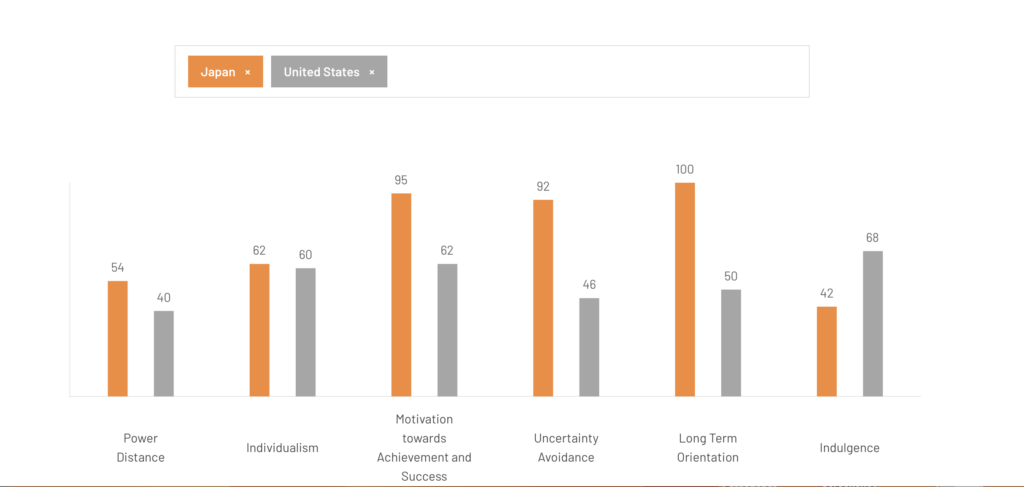
One of the more familiar tools for comparing cultures at scale is Geert Hofstede’s cultural dimensions model, “the 6-D Model.” It represents six axes, including individualism-collectivism, each scored from 0 to 100. Applied to a long list of countries, the model has become close to a default reference point in cross-cultural training, a useful first orientation before anyone has spent real time in a place. On the individualism dimension in particular, Japan scores 62, while the USA stands at 60.
While numbers like these are a reasonable place to start a conversation, they are not so reliable a place to end one. This is even more true when the number does not match what is happening in the room.
My first year in corporate Japan was full of surprises. The learning curve was unexpectedly steep. Like most people coming from the western hemisphere, I struggled to accept the fact that I was not supposed to make decisions on my own despite the fact that I was hired to work on very specific tasks, alone, as nobody else in the organization had the skillset for that particular job. Through trial and error, I learned what ‘horenso’ (short for 報告,連絡,相談) was and how consensus was built to ensure that everybody on the team was onboard before the launch of any project.
Through the years, I have also heard many expatriates say that Japanese employees do not personal opinions, they are uniform not only in appearance but in thought, too.
This cannot be farther from the truth
Like everywhere else, personal thought exists in Japan. Personal ambition, private opinion, the pull to excel at what you love doing… all of this is part of human nature. Individualism in this sense is universal, and regardless of our cultural backgrounds, we all are human beings.
One of the places where personal drive is unmistakable is hobbies. The pursuit of mastery in something a person is deeply passionate about – a musical instrument, a martial art, a craft – is a continuum and goes far beyond the point of casual interest that holds little longer than a few moments. And yet, even here, the preferred way to get better is seldom solitary. Many individuals join interest groups where they pursue their ambition to improve through shared practice and mutual feedback, rather than alone. While the passion is personal, the path to improving at it is communal.
Stepping into the business world
Something similar happens inside workplaces and it is easy to miss it when you are new to the environment. Take nemawashi for example. The practice (or shall we call it “process”?) of building agreement before a decision is formerly proposed produces a meeting where every stakeholder appears to endorse the same idea for the same reason. But if you join the nomikai that follows a meeting like this, you see an entirely different picture: most people in the room privately disagreed with some part of the decision. Yet, they gave it a green light because they judged it to be what the organization needed and let that judgement outrank their own. They form opinions independently and then deliberately set them aside for the sake of the organization. Group members usually act on the decision after everyone has approved it as the way forward.
Having an opinion is different from acting on it
In cross-cultural studies, when we say that a country is “individualistic”, we do not talk about the existence of individual minds there but about something narrower and more consequential. An individualist culture is where the society is organized so that individuals routinely act on their own judgement without waiting for a group’s authorization first.
In both situations above, the individual mind is present and active but the individual is not acting alone on the strength of that mind, which “individualistic” is supposed to mean as a description of a society. In Japan, the willingness to set that mind aside is not reluctant or simply tolerated. That willingness is, in itself, a value. When compromising a personal opinion serves the group’s benefit, people are ready to do so, to a certain extent, because they perceive the group’s benefit as worth that trade.
The circle that keeps moving
In Japan, individuals do originate ideas but, in my experience, they seldom realize those ideas unilaterally. They require the authorization of whoever constitutes “the group” in that particular situation. It could be the immediate family, a team of three, a division or an entire organization. What changes is not the necessity or lack of authorization but the group that holds and gives it.
In one situation, the group whose authorization matters is your immediate team who will cover for you when you are on sick leave, and without whose buy-in and idea does not move forward. A day later, in a negotiation with another division of the same company, the relevant group has shifted upwards: the decision requires the company’s sanction and internal disagreement at the team level becomes invisible to the outside observer. If you put the same person in an international trade delegation, when it is Japan itself being represented, no individual, however senior, is acting out of that mandate.
In Japan, the group authority is never absent, regardless of who constitutes “the group.” An idea that needs the immediate family agreement for a personal decision needs the division’s agreement for a work decision, and the company’s agreement for anything that touches its external standing. The obligation to build consensus before acting changes the address but doesn’t loosen.
Even the data does not agree with itself anymore
There is a footnote to this that is worth knowing if you ever cite Hofstede’s numbers in a client conversation. The individualism score widely used today is no longer the original one. The change helps understand why “Japan is individualistic” has started showing up in charts.
In 2022, researchers Michael Minkov and Anneli Kaasa published e revised version of the individualism dimension (“Do dimensions of culture exist objectively? A validation of the revised Minkov-Hofstede model of culture with World Values Survey items and scores for 102 countries” and Vollmann et al., “New developments in Hofstede’s Individualism-Collectivism: A guide for scholars, educators, trainers, and other practitioners“, built from World Value Survey Items, including attitudes toward abortion and homosexuality, obedience versus thrift as values to instill in children, and religiosity, rather than Hofstede’s original questions about self-reliance and loyalty to the in-group.
The Culture factor, which now manages the public-facing Hofstede country-comparison tool, adopted this revised data for two of the six dimensions on its charts. As a result, Japan and the United States, which used to sit 45 points apart (Japan at 46band the US at 91), now show up almost identical (Japan 62 and the US 60).
What the numbers measure
While that number is measuring something real, what it is measuring is not what I describe here because attitudes towards social liberalism are not the same thing as whether a person can act on their own judgement without a group’s sign-off. Conflating the two is why a country can end up looking “individualistic” on a chart while every hobby club and every nemawashi tells a different story.
It is important to note that Geert Hofstede’s son and research successor, Gert Jan Hofstede, has publicly flagged this issue: two different questions wearing the same label have produced two very different pictures of the same country pare.
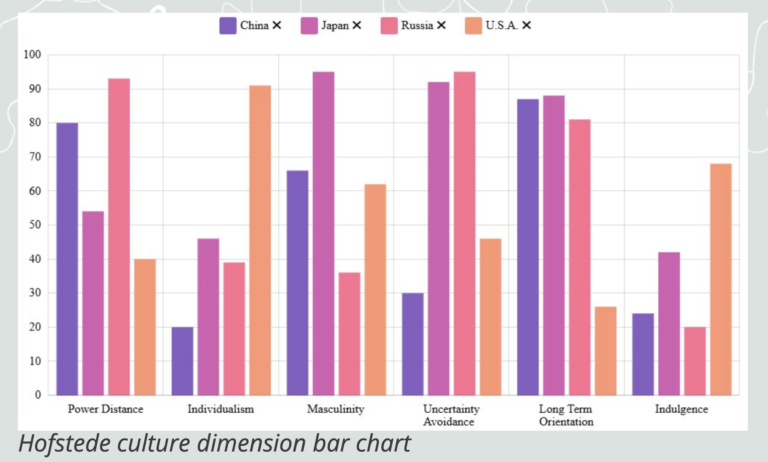
So the newer number saying that Japan and the US are almost the same in terms of individualism is not new information. Rather, it is a reminder to ask what exactly a chart is measuring before we let it stand in for what we have observed on the ground.
What it means in the meeting room
If you are negotiating with, managing, or partnering with a Japanese organization, the practical takeaway is to not wonder how individualistic or collectivist Japan is but to ask which group’s authorization you need for the task at hand, so that the idea can move forward.
If the group is the unit that matters, a company’s care for its members looks different from what many Westerners expect. See why Japanese companies protect their employees to survive, not out of kindness.
Reading Japanese business behavior well means tracking which group currently holds the authority to say yes. And it is a skill that is very different and much more valuable than applying a fixed collectivism score and expecting either the group or the individual to hold steady across every context.