
What Holds When A Disaster Strikes
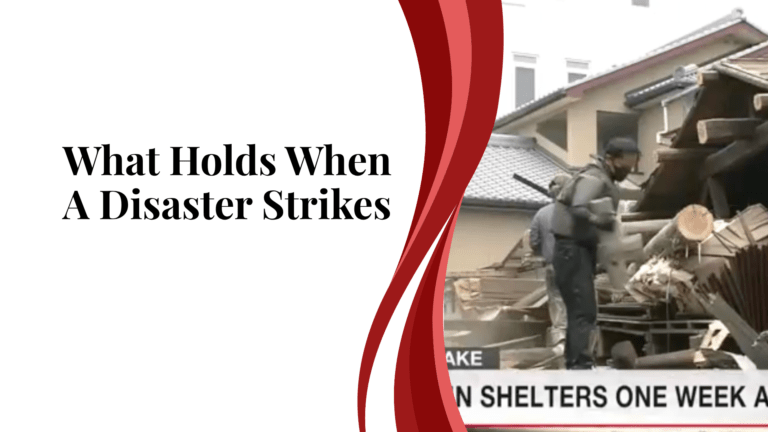
Image credit: NHK World, Source: https://www3.nhk.or.jp/nhkworld/en/news/20260804_09/
Written by Maya Matsuoka
On July 28, a M7.1 earthquake struck Kumamoto, in Japan’s Kyushu region. Everybody in Japan is watching the reports on casualties, loss of life and physical damage. The region’s public transport services are disrupted, some streets and highways are unusable, and many buildings will probably be damaged by the continuing aftershocks. As I write this, search and rescue efforts are still underway and the death toll continues to rise; my thoughts are with everyone affected, and with the communities now facing the long work of recovery. Watching the coverage this morning, my mother-in-law said: “This is because of such disasters that we need to maintain good relationships with our neighbors and everybody in and out of the immediate community.”
Her comment took my attention away from the TV screen, on to the social infrastructure that almost immediately begins to carry people through the crisis.
When Community Becomes Critical Infrastructure
In Japan, relationships with neighbors and community members are usually perceived as an expression of collectivism or community spirit. While there is certainly truth in that, these relationships are also very practical. Living on a seismically active archipelago means accepting that disasters are in fact recurring realities and not theoretical. When roads are blocked, trains stop running, electricity fails, or communication networks become unreliable, the people around you become your first source of information, assistance, reassurance, and even survival.
In disaster-prone countries like Japan, strong communities are not maintained just because people enjoy peeking into one another’s lives, although it may eventually become a byproduct of the process. People develop and maintain their communities because, over generations, experience has shown that trust, reciprocity, and mutual responsibility become part of the social fabric. They have repeatedly proved their worth when circumstances are at their worst.
This brings back a brief conversation of a podcast I listened to a couple of years ago. The host asked a guest who had lived in Japan what western societies could do to become more orderly. The answer was straightforward: become “10% less individualistic.” It is an appealingly simple explanation but societies do not work that way.
Culture Is Built, Not Adjusted
While scientists and cross-cultural researchers have developed models that contrast individualism and collectivism, these cultural dimensions are not settings on a dial that can be adjusted by ten, fifteen or twenty percent.
They emerge from history, geography, institutions, education, incentives, and countless shared experiences that have been accumulated over generations. Japan’s emphasis on social coordination did not appear because at some point of time, people collectively and suddenly decided to value harmony more highly. It developed because, repeatedly, cooperation proved essential for communities facing earthquakes, tsunamis, typhoons, fires, limited natural resources, and the day-to-day realities of living in close proximity.
What appears as courtesy, discipline, or social conformity to outside observers, is in fact a long-evolved system of risk management. Maintaining relationships, participating in neighborhood associations, knowing the people nearby, and considering the impact of one’s actions on others are not just social niceties. They are mechanisms that make society more resilient in times when everyday life is disrupted by the next natural disaster.
The visible behaviors of people waiting in line, neighborhoods organizing clean-up activities, and volunteers responding without hesitation in times of crisis are sustained by an invisible network of relationships and mutual expectations, cultural values and systems that have been reinforced over generations.
Kumamoto will rebuild, as it did after the earthquakes in 2016. Engineers and emergency services will carry it through the coming weeks and months. But more important than that, it will be the accumulated, unglamorous work of people who have spent years being good neighbors to one another, in and beyond their immediate community. In Japan, the group-oriented mindset and appreciation of smooth interactions are about much more than not standing out. These are about building a society – and businesses if you wish – that, in times of crisis, are able to withstand the most difficult of their days.
If you are curious to learn more about Japan and the mindset of Japanese people, you might find this article interesting, too: “Innovation in Japan: Beyond the Disruption Narrative“.